
Top Signs You Need Garage Door Service – Don’t Ignore These
By the time your garage door sounds bad, you’ve already missed the three weeks of quiet signals that could have made the repair half the price. Grinding, squealing, and visible shaking are late-stage symptoms. The failures that actually cost homeowners money announce themselves weeks in advance through mechanical clues most people never notice. Here are the early warning signs worth watching in Kensington. If you’d rather not climb around the door yourself, call (833) 439-5277. We answer 24/7.
Why the Noisiest Door Isn’t the One in Trouble
A door that squeals is usually just asking for lubrication. A door that has gone strangely quiet, or that runs slightly slower than it did a month ago, is often the one closer to a serious failure. That gap between how bad a door sounds and how bad it actually is trips up a lot of do-it-yourselfers in Kensington.
Garage doors fail in a predictable order. Springs lose tension, cables fray, rollers wear down, and the opener motor takes up the slack – quietly compensating for problems upstream. By the time the problem becomes audible or visible, the system has usually been straining for weeks.
This post focuses on those upstream indicators. The signs below are mechanical, mostly silent, and genuinely predictive of a failure two to four weeks out.
Key Takeaways
- The signals that matter most are visual and behavioral, not audible.
- A balance test takes 30 seconds and reveals spring tension issues early.
- Cable inspection focuses on the bottom corners – nowhere near the springs.
- Tracking opener run-time creep is one of the most overlooked diagnostics.
- When in doubt, get a trained eye on it. This system is under real tension.
1. The Balance Test Signal Nobody Checks
If your door won’t stay put at the halfway point, the springs are telling you their tension has drifted out of balance. This is the single most useful check you can do yourself, and almost nobody does it.
How the balance test works
- Close the door fully. Pull the emergency release cord to disconnect the opener.
- Lift the door by hand to about waist height – roughly the halfway point.
- Let go. A healthy door holds still or creeps a few inches and stops.
- A door that sinks toward the floor has springs that have lost tension. A door that rises on its own is over-tensioned.
Either result means the springs are out of adjustment or nearing the end of their life. Springs carry the entire weight of the door, so when they weaken, the opener motor starts pulling harder to compensate. That’s the strain that shortens the life of a lift motor, whether it’s a Chamberlain, a Genie, or anything else.
We can’t stress this enough: the balance test ends when you let go of the door. Don’t attempt to adjust the springs yourself. Torsion and extension springs are under enormous stored tension, and a spring that lets go can cause serious injury. This is the job that separates a garage door specialist from a generalist.
2. Cable Fraying at the Bottom Corners
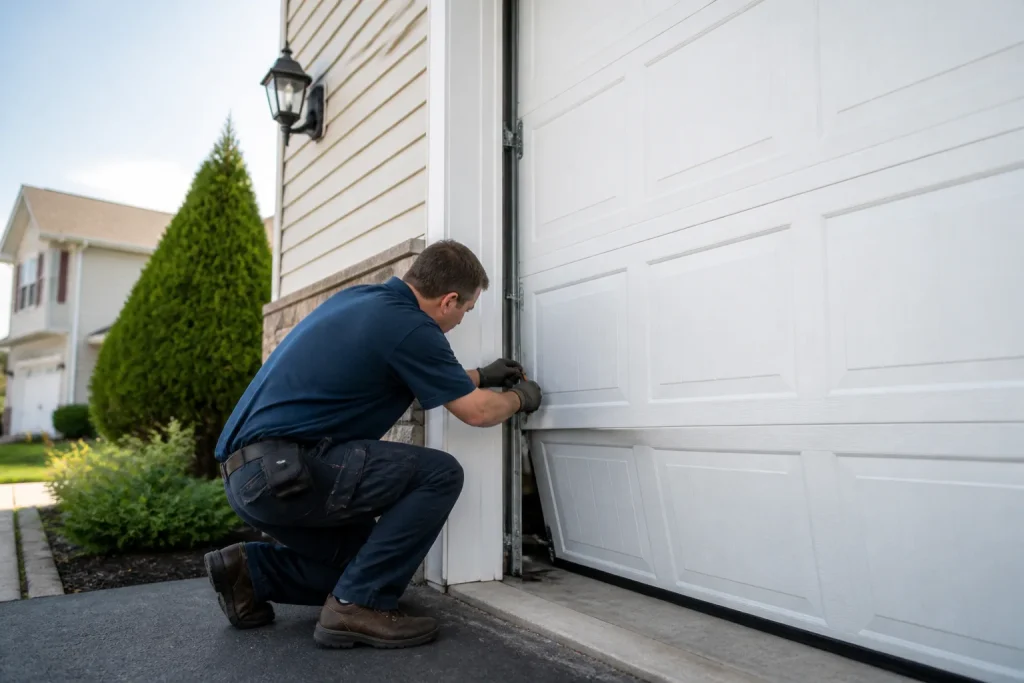
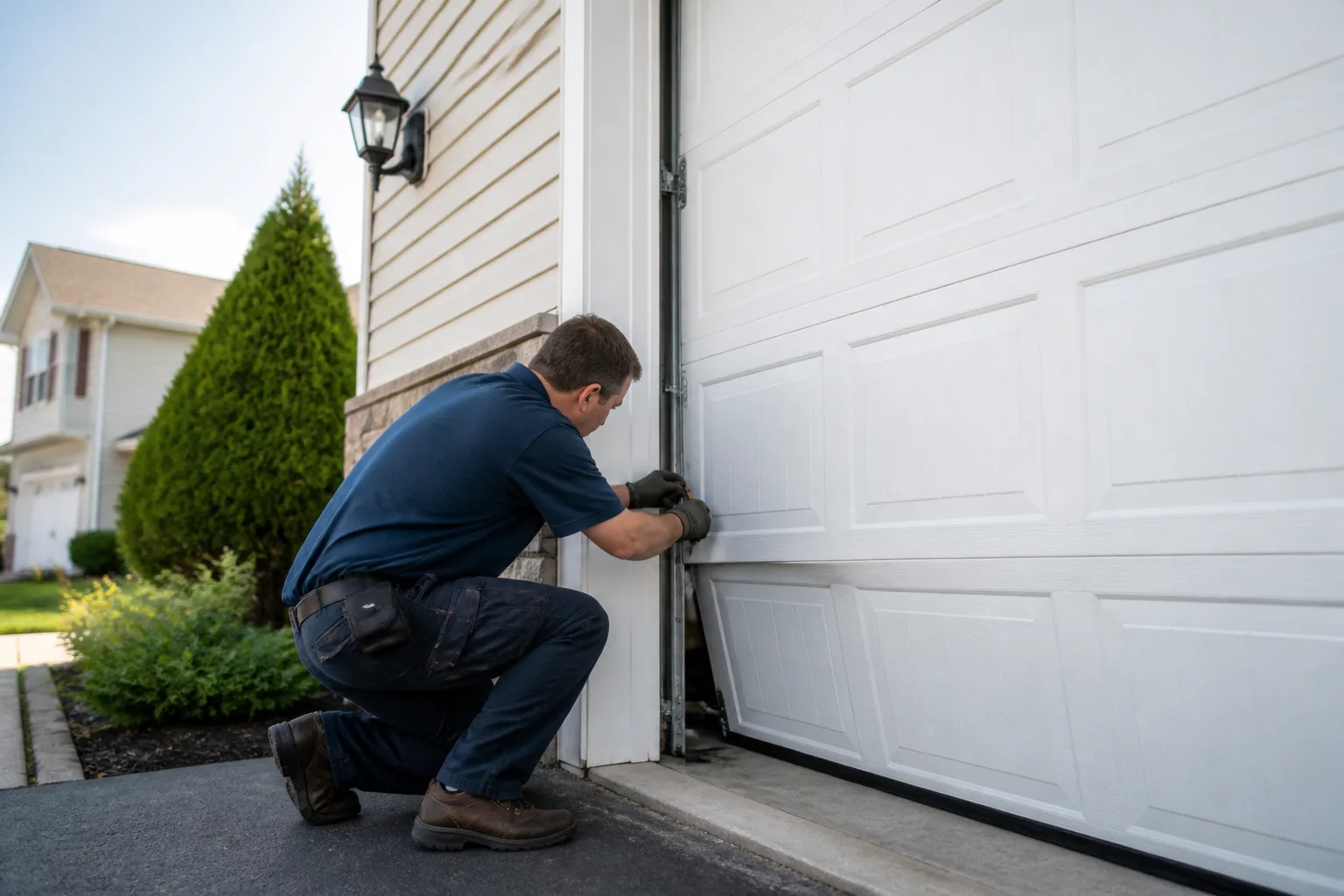
The easiest cable inspection happens at the bottom corners of the door, and it requires no tools and no ladder. You’re looking for fraying, kinks, or a fuzzy texture where smooth steel should be.
Where to look
- At each bottom corner, follow the cable from where it anchors on the door up toward the track.
- Look for broken strands, kinks, or a section that’s visibly thinner than the rest.
- Check the pulleys near the bottom for cable that’s jumped out of its groove.
Cables fray in one of two ways: gradually, from normal wear, or suddenly, when the door binds on one side and the cable takes the load. A single broken strand is your signal that a cable is weeks away from snapping. A snapped cable drops one side of the door, and that’s a situation to stop using the door over – don’t run the opener on a door with a visibly damaged cable.
You should never reach above the bottom of the door to inspect cables on the spring side. Leave that to a trained technician. In Kensington homes, doors that sit exposed to seasonal temperature swings tend to see more cable stretch and binding than people expect.
3. Weatherstripping Compression Failure Predicts Track Wear
Most people think of worn weatherstripping as an insulation issue. It’s actually an early indicator that your tracks are migrating out of alignment.
The bottom seal compresses evenly when the door closes square in its opening. When the seal shows uneven wear – worn thin on one side while still full and soft on the other – it usually means the door isn’t sitting level. That uneven fit puts asymmetric load on the tracks and rollers, and over time that’s what causes a door to bind and jump off track.
How to check it
- With the door closed, look along the bottom seal. Is the gap to the floor even all the way across?
- Press the seal. A healthy seal flexes evenly and springs back.
- Look at the side weatherstripping too. Uneven compression on one side is another alignment signal.
If you catch the misalignment at the weatherstripping stage, you’re often looking at a track adjustment and a fresh seal. If you miss it, the same problem can wear through your rollers and eventually force a repair to the track itself. Catching it early is the difference between maintenance and repair.
4. Opener Run-Time Creep: The Silent 15% Problem
If your door seems to take a few seconds longer to open than it used to, your motor and springs are working harder than they should. This is the most invisible signal on the list.
Run-time creep is exactly what it sounds like: the door slowly takes longer and longer to complete each cycle. Fifteen percent more time per cycle is enough to confirm the door is loading the opener beyond its design. Most homeowners never register it because it happens gradually over weeks.
The cause is usually one of two things: a spring that’s lost tension, or a door that’s binding on one side. The opener compensates without complaint until it doesn’t. If your opener is a newer model, the motor may even throw errors or reverse at the end of a cycle – that’s a safety stop, not a fault in the motor.
Watch for run-time creep across brands. Chamberlain and Genie openers both log door travel in memory, and a model with smart features can sometimes flag the change in the app before your eye catches it. Either way, the fix is usually on the door side, not the motor side.
5. The One Roller That Fails First on a Standard 16-Foot Door
On a standard 16-foot door, the roller that fails first is almost always the one at the top of the short hinge closest to the opener motor. No tools required to spot it.
That roller takes the most load and the most stress from the opener pulling the door up. Look at it and compare it to the others: it will show the most wobble, the most wear in the plastic edge, and the most vibration while the door is in motion.
What to check for
- Wobble at the stem where the roller meets the hinge.
- Visible grinding tracks or flattening on the plastic wheel.
- Nylon rollers that have turned gray or developed a rough, textured surface.
- Rollers that have stopped spinning and are dragging against the track.
A single dragging roller adds load to the door on every cycle. Replace it early and you save the wear on the track that follows. Clopay and Amarr steel doors use this roller layout across most of their standard residential models, so the failure point is consistent across brands. We keep that replacement in mind as one of the cheapest fixes on a garage door – if you catch it before the track wears.
When to Call a Pro
Balance-test results that show movement, frayed cables, doors that bind on one side, or an opener that reverses at the top of travel – all of these call for a trained technician. Springs are dangerous and none of the checks above involve working on them. The full-service scope at Garage Door Repair Kensington covers repair, springs, openers, and full replacements, so you won’t need a second company for any stage.
Compatibility matters here. The team is set up to work on doors and openers from eight major brands including LiftMaster, Chamberlain, Genie, Clopay, Amarr, Wayne Dalton, Craftsman, and Raynor. If your door has any of these – which covers nearly every door in Kensington – the technician arrives knowing the model and door type.
For general troubleshooting and repair when something’s already gone wrong, garage door repair handles it. If the issue is on the motor side – opener reversing, remote not responding, or safety sensors acting up – garage door opener repair is the right call. Unless the door itself is beyond saving, you’re looking at repair, not replacement.
Our technicians have up to 10 years of experience with this exact system – springs, cables, tracks, rollers, and openers. We answer 24/7. Fast dispatch from 7am to 7pm, Sunday through Friday.
Signs That Mean Replacement, Not Repair
Not every warning sign leads to a repair bill. Some mean it’s time for a new door – and spotting that early is a favor to your wallet, because a door that’s been failing for weeks usually takes the tracks and the opener with it.
- Multiple panel sections show denting, sagging, or rot at the bottom rail.
- The door has had more than two major repairs on the same problem.
- Tracks are bent beyond what a realignment can fix.
- The door’s structure is showing it can’t hold its square anymore.
A full replacement is the right answer when the door’s core structure is failing, not just its moving parts. garage door installation covers new doors and openers, sized and measured for the opening, with the price written up front as an estimate. Replacement work is measured, ordered, and scheduled – it’s not a same-day job – so the better move is to spot the signs and plan for it.
If you’re not sure whether your door is on the repair-or-replace line, a free estimate settles it. No one touches anything until the price is quoted and agreed. Kensington homeowners don’t need to guess at the cost.
The Bottom Line
The warning signs that matter most on a garage door are the quiet ones: a door that drifts at the halfway point, a cable that’s gone fuzzy at the corner, weatherstripping that’s worn unevenly, a door that takes a beat longer to open, and one worn roller near the opener. Catch any of those early and you’re usually looking at maintenance, not a rebuild.
If you’re in Kensington and need help, Garage Door Repair Kensington offers free estimates – call (833) 439-5277. We answer 24/7. Fast dispatch from 7am to 7pm, Sunday through Friday. If you’re not sure what you’re looking at, describe it over the phone. We’ll tell you whether it sounds like a today problem or a this-week problem.
Frequently Asked Questions
Spring repair in Kensington typically runs $180-$340 for one spring, estimated. A matched pair costs about twice that when replaced together, which is the usual approach. The written estimate sets the final price, and the price is quoted and agreed before any work starts. Call (833) 439-5277 for an exact quote – estimates are free.
Yes, for genuine emergencies, same-day service is on the table. We answer 24/7, with fast dispatch from 7am to 7pm, Sunday through Friday. A call outside dispatch hours is booked into the next opening. If your door won’t close, won’t open, or a cable has snapped, call so we can get a technician out.
No. The written estimate is the price. The technician looks at the door, quotes the job, and starts work only after you agree. A specialist’s focus is on the diagnosis and the repair, not on adding line items once the work is underway.
The local pro who arrives is licensed and insured as the state requires, and works exclusively on garage doors. That single-trade focus is the point – springs, cables, tracks, rollers, and openers are what the technician sees every day. Call (833) 439-5277 for a free estimate.
Written by the team at Garage Door Repair Kensington.
Need Garage Door Help?
Call Garage Door Repair Kensington - the local pro we connect you with is licensed and insured, here with fast help in Kensington.
(833) 439-5277